
Ministry of Highways
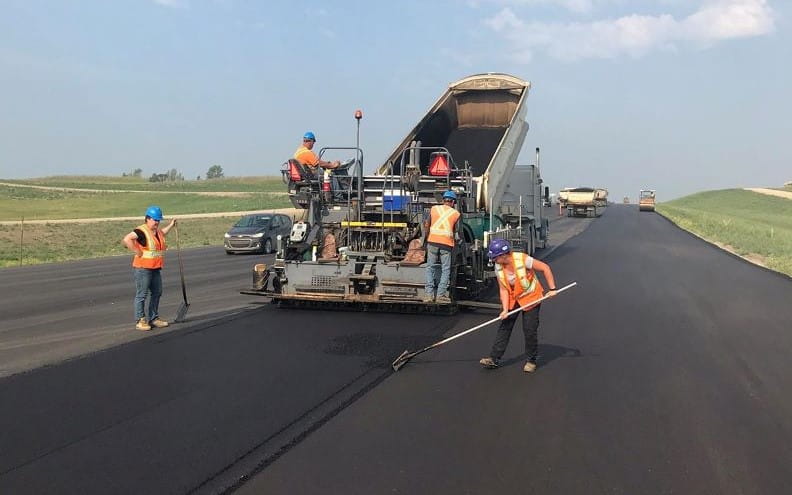 We work with our partners in transportation to ensure travel is safe. Connecting Saskatchewan to the rest of the world is vital to our export-based economy.
1. Information you might be looking for
Check Highway Road Conditions
The Highway Hotline provides motorists with the most current information about highway conditions.
Highway Work Zones
Learn why you must slow down in a work zone, what the proper speed is, and how to report a work zone sign problem.
Winter Road Safety
Find information on which highways we clear first and why; snow and ice control; safe driving practices around snowplows; how we use the latest technology for improved service; and how to access the latest winter road conditions before heading out.
Information for Truckers and Trucking Companies
Learn about maximum weights, high clearance corridors, road restrictions, weigh scale locations, increased moving over-width dimension goods, buildings and permits for commercial vehicles.
Contracting with the Ministry of Highways
Find information for contractors, consultants and others about doing business with the Ministry of Highways.
Public Sector Purchasing in Saskatchewan - SaskTenders
SaskTenders is your window to public sector purchasing in Saskatchewan. Businesses can review and bid on all posted tenders from the provincial government and municipal governments, as well as the Crown, health and education sectors.
Working with Highways
Are you looking for a rewarding career? Join us to support highway and citizen safety in Saskatchewan.
2. Plans and Annual Reports
Plan for 2024-25
The plan for 2024-25 reflects the government's goals of sustaining growth and opportunities for Saskatchewan people, meeting the challenges of growth, securing a better quality of life for all Saskatchewan people and delivering responsive and responsible government.
For previous ministry plans, please visit Prior Year Plans, Reports and Guiding Documents.
Annual Reports
The Ministry of Highways' 2022-23 Annual Report presents the ministry's activities and results for the fiscal year ending March 31, 2023. It reports to the public and elected officials on public commitments made and other key accomplishments of the ministry.
Previous fiscal year annual reports can be found by visiting Prior Year Plans, Reports and Guiding Documents.
3. Programs and services
Adopt a Highway
The Adopt-A-Highway Program is a way for groups or participants to help beautify Saskatchewan by picking up litter and trash along the highway.
Buying and Selling Land for Highway Projects
Some highway projects require the Ministry of Highways to buy land. Learn about some of the examples of these improvements and the processes.
Memorial Markers
An individual or family's need to grieve the loss of loved ones is necessary for some of us. Learn what the ministry will allow regarding commemorative markers.
Markers must be at least 100 metres from any intersection and should be a reasonable size and not exceed 80 cm by 60 cm.
Rural and Urban Road Closures
The Ministry of Highways must review requests for some road closures, encroachment agreements, title transfers and new road plan registration. Learn about requirements and service fees.
Snow Zone and Winter Maintenance
Learn more about how we approach severe weather during the winter including different levels of service and how they may affect you.
Spring and Summer Maintenance - Why some roads have more potholes than others
Potholes are formed by the expansion and contraction of water that has entered into the subgrade of the road through cracks in the pavement. When water freezes it expands. This causes the pavement to expand, bend or crack weakening the road. If water freezes and thaws over time, the road can weaken
4. Ministers and managers

Hon. Lori Carr, Minister
Minister's Office
| Phone | 306-787-6447 |
|---|---|
| Fax | 306-787-1736 |
| hi.minister@gov.sk.ca | |
| Mailing Address | Room 322, 2405 Legislative Drive, Regina, SK, S4S 0B3 |
Kyle Toffan, Deputy Minister
Deputy Minister's Office
| Phone | 306-787-9311 |
|---|---|
| Fax | 306-787-9777 |
| kyle.toffan@gov.sk.ca | |
| Mailing Address | 1200, 1855 Victoria Avenue, Regina, SK, S4P 3T2 |
Tom Lees, Assistant Deputy Minister for the Operation and Maintenance Division
Deputy Minister's Office
| Phone | 306-787-4859 |
|---|---|
| Fax | 306-787-9777 |
| Tom.Lees@gov.sk.ca | |
| Mailing Address | 1200, 1855 Victoria Avenue, Regina, SK, S4P 3T2 |
Wayne Gienow, Assistant Deputy Minister for the Design and Construction Division
Design and Construction
| Phone | 306-787-1355 |
|---|---|
| Fax | 306-787-9777 |
| Wayne.gienow@gov.sk.ca | |
| Mailing Address | 1200, 1855 Victoria Avenue, Regina, SK, S4P 3T2 |
Ryan Cossitt, Assistant Deputy Minister for the Policy, Planning and Corporate Services Division
Deputy Minister's Office
| Phone | 306-527-8334 |
|---|---|
| Fax | 306-787-9777 |
| Mailing Address | 1200, 1855 Victoria Avenue, Regina, SK, S4P 3T2 |
Shannon Lindholm, Executive Director
Communications and Customer Service Branch
| Phone | 306-787-6815 |
|---|---|
| Fax | 306-787-9777 |
| shannon.lindholm@gov.sk.ca | |
| Mailing Address | 1200, 1855 Victoria Avenue, Regina, SK, S4P 3T2 |
Lori Janz, Executive Director
Safety and Environment Resource Branch
| Phone | 306-933-5190 |
|---|---|
| lori.janz@gov.sk.ca | |
| Mailing Address | Unit #18, 3603 Millar Avenue, Saskatoon, SK, S7P 0B2 |
5. Forms and publications
You can find all publications for this ministry in the Publications Centre.
6. Legislation
The following acts and regulations are administered by the Ministry of Highways and are available in PDF format. The links below are provided with the consent of Office of the King's Printer pursuant to Government of Saskatchewan copyright policies. Printed copies of the legislation are also available through the Freelaw® website.
To order or subscribe, please visit the Freelaw® website. If you don't have Adobe Reader on your system, you can download it for free.
7. News releases
Read the ministry's most recent news releases
-
Highway 10 Passing Lanes Project To Move Forward Between Fort Qu'Appelle and Melville
Today, Highways Minister Lori Carr announced Highway 10 passing lanes will be moving forward between Fort Qu'Appelle and Melville as part of the...
-
$530,000 Investment Keeps Short Line Rail Infrastructure On Track
Today, Highways Minister Lori Carr announced $530,000 in provincial short line rail investments that will keep this key transportation...
-
Secondary Highways Start Spring Weight Restrictions Today
Today, spring road weight restrictions began to protect a key part of Saskatchewan's transportation network as the province shifts from freeze to...
-
$741.0 Million Highways Budget Meets the Needs of a Growing Province
The Ministry of Highways' $741.0 million budget for 2024-25 will improve more than 1,100 kilometres (km) of highways, enhance safety, invest in...
-
Engineering and Geoscience Week Proclaimed March 3 to 9 in Saskatchewan
Highways Minister Lori Carr has designated March 3 to 9 as Engineering and Geoscience Week in Saskatchewan to recognize the pivotal role played by...